Now this is a longish post and contains everything I know about applying for higher studies, selecting universities. I was in this situation a few months back and had no idea to do what, where, how, when and for how long. Fortunately, I was able to find someone amazing who helped me out every single step of the way. Honestly, I doubt I’d have been able to get anywhere without her. Not everyone may be able to find someone like this. Even if you do, you may not want to bug someone so much; not to mention, you’d feel much more confident and in control if you yourself had a good idea of what lies ahead and everything that needs to be done.
Of course, if you’re reading this, I assume you’ve decided on wanting to pursue higher education. Your reason may be weird, but if it’s good enough, it works. I’m no career counsellor, and neither are a lot of people. The decision has to be taken by you. In my case, I simply wanted to do a Masters because I felt I needed more exposure to the outside world and a single undergraduate degree from a top institution in the country just didn’t cut it for me. You have a different reason? Sure! Go ahead. I’ve seen people decide overnight they want to do a Masters. Some want to specialise in a field of study, some see it as a ticket overseas, some do it because they don’t want to get into a job too soon. Whatever your reason be, discuss it with your parents, friends and blah. You get the idea.
I’m not too confident about the procedures in the European schools. They’re quite similar to the ones in USofA, but one can never be sure.
So. Where does one start?
Well, there are exams you need to give, universities you need to decide, programs you need to look at, profs and projects you need to delve into, CG you need to maintain (or do you?), resumes you need to build, statements you need to write, profs you need to bug, etc. There’s all that. It can be overwhelming at first, but one step at a time.
So most of the deadlines (for joining the university in the Fall semester) are in December. That means, you’d ideally want to be done with your GRE and TOEFL by September end giving you enough time to write your statement of purpose, decide on schools, etc. (I HAVE seen people give their GRE in late October too and still make it!). Getting done with the GRE early also gives you enough buffer time in case you have to write it again (you can only give it once in three weeks)
Let’s talk about all of these things (approximately in the order you’d be doing them in).
GRE
GRE doesn’t matter as long as you don’t screw it up. The bitter truth is once you are beyond a certain score, the exact number doesn’t really matter.
This is a test on 340 in which there are two sections — English and Quant (both of 170 marks each). There’s a separate section on writing skills which is of 6 marks that aren’t included in the 340. So what’s a safe score? Well, I’d say, as long as you’re scoring above about 320 (325 if you want to be super safe), you’re good. Score above this and your GRE score is not going to matter. The GRE score might come into play in the hypothetical situation that there are two candidates competing for a spot and everything else in their profiles is on par. Too small a possibility to worry about.
The English section needs prep; the quant is something that you’d be quite used to if you’ve been through the traditional Indian schooling system. Assuming you’re putting in a couple of hours a day, I’d say you need on an average of a 3 weeks prep for the GRE (subjective obviously).
To prepare, I had all sorts of books and resources available to me, however the only two things I used were -
- GRE Flash cards for Android — http://sh.st/BbAbR (The same are also available for iOS)
- http://sh.st/BbAE0
Sure Magoosh does cost quite a bit, but it’s worth it. There’s nothing more that you need if you use their test prep software. It’s simply the BEST test prep material out there. If you’re paying so much for the test itself, might as well pay a bit more and make sure you do it right in the first go.
Magoosh has numerous practice questions and stuff that will get one acquainted with the GRE format, things to watch out for in the test, etc.
To prepare for essays, there are some very useful sample essays on the ETS website that one can go through. Each essay is graded on a score from 1–6. The sample essays show how an essay is graded, the difference between a 4/6 essay and a 5/6 one.
ETS also gives you two free tests to take. These tests are the closest they can be to the actual GRE. So it’s often a good idea to take these a few days before the GRE.
Sending your scores
Once you’re done taking your GRE, you need to send these scores to the university you plan to apply to. Sure, you don’t need to do this immediately; you can postpone that for a few months later. But ETS allows you to send the scores to 4 institutions for free right at the end of the test. So it does help to get a fair idea of the colleges you’d be applying to. Sending to more schools costs 29$ per school.
NOTE — You need your passport to give the GRE and TOEFL
TOEFL
Now after the GRE, the TOEFL is a piece of cake to be frank and nothing more than a formality. I gave the TOEFL three days after my GRE.
TOEFL tests you on four parameters — reading, writing, speaking, listening. The only section you’d need to practice would be the speaking section.
The test is on 120 (30 for each section) and the highest filter I’ve seen set by a university for application is 108. Getting above that score should be a piece of cake. I’ve had friends score full in the test.
ETS also lets you send your TOEFL scores to 4 universities for free. However, unlike GRE, the universities need to be decided prior to taking the test. 17 bucks per school after that.
Statement of Purpose
Two pages long. Your best shot to sell yourself to the admission committee. Some universities have their specifications about SoPs though. Some may want it no longer than one page, some set a character limit, etc (Heck, NYU wanted a VIDEO SoP). Irrespective, whoever ends up reading your SoP will in all probability not spend more than a minute or 30 seconds glancing through it.
Write your version 1.0 on your own first. Do not look at someone else’s statement before you do. You run the risk of losing out on your originality otherwise. Then go ahead and take a look at other’s SoPs from the past in the same field as yours. Taking inspiration, make appropriate changes to yours. Get as many people as possible to give you their opinion on it, go through it, suggest changes. Reason with them about the same and make changes you seem fit. Writing an SoP can be a tiring and draining task. Even after 11 or 12 versions, you never really feel like you’re done. There ALWAYS seems to be room for improvement. Writing the SoP can easily take 2–3 weeks. And it’s completely okay to give it this amount of time given it’s importance.
Your statement of purpose gives form and shape to your credentials. Sure, you have your GRE score, your GPA, your internships, publications, projects, etc. but it’s your statement that gives the reader a perspective to view all of that from. A good SoP makes the reader see the good even in the bad (without doctoring any of the details). Your GPA fell drastically in junior year. Well, yeah but you gained loads of experience organising your college fest! You learnt what went wrong and made sure you did better the next semester. Maybe you were instead focussing on your projects which can clearly be seen in that publication you got or the amazing results of the project or the good project grade! What made you take on research projects suddenly? What was the new found motivation? Why did you score poorly in X course? Don’t try and hide the bad stuff hoping they won’t notice. Given the number of applications they go through, chances are they will and if they’re unable to find a reasonable explanation/mention of it anywhere, your application might be discarded without a second thought.
When I was applying to grad school, my CGPA was in the WORST possible situation it could have been. It had been on a CONSTANT decrease since the first semester. Due to the snail paced administration of the college, I had an incomplete grade in my Honours project (which would have helped bring my semester GPA from 5 to a 6 point something, but alas!), I had received my record lowest grades the previous semester and the course of the very specialisation I was applying to (computer vision) — the field I claimed to be an expert in, had a shining C-written next to it. With all of that going on, I should’ve been a straight out reject. But I addressed it subtly in my SoP. That’s probably what saved me. Because if that didn’t, I have no idea what did.
No matter how confused you are, your SoP needs to reflect an absolutely clear stream of thought. I had no idea what in Computer Science I wanted to pursue in grad school. But fact was most of my projects were in Computer Vision (CV), all my LoR’s were from profs very highly regarded in the field, I had a CV internship, a CV paper submitted and awaiting decision (oh yes, even more bad timing. My biggest publication would only have its result out WAY AFTER all the grad school deadlines). So heck yeah, my SoP needed to be all about me wanting to do CV more than anything else. There was no other way to go about it (note that once you’re admitted to a generic computer science program, you can go in and pursue whatever you want; you’re not tied to what you wrote in your SoP)! I tried writing a statement that explained why I wanted to change streams and try something else (with no idea what this something else was); I read it once and trashed it. So even if you’re changing streams, be very careful in the way you go about presenting your situation. Give hard facts that support your thought of wanting to switch.
Also, the problem with most of the SoPs is not the grammar or the fancy vocabulary but the flow of it. It is critical for the whole statement to make the rough storm stricken journey of college seem like a cruise in perfectly calm waters on a nice and bright sunny day. Make sure adjacent paragraphs are connected well, so the reader doesn’t have to go back and forth wondering where some stupid random achievement suddenly butted in from. Get someone to read your statement and check to see if they have a confused expression at any point.
Choosing Schools
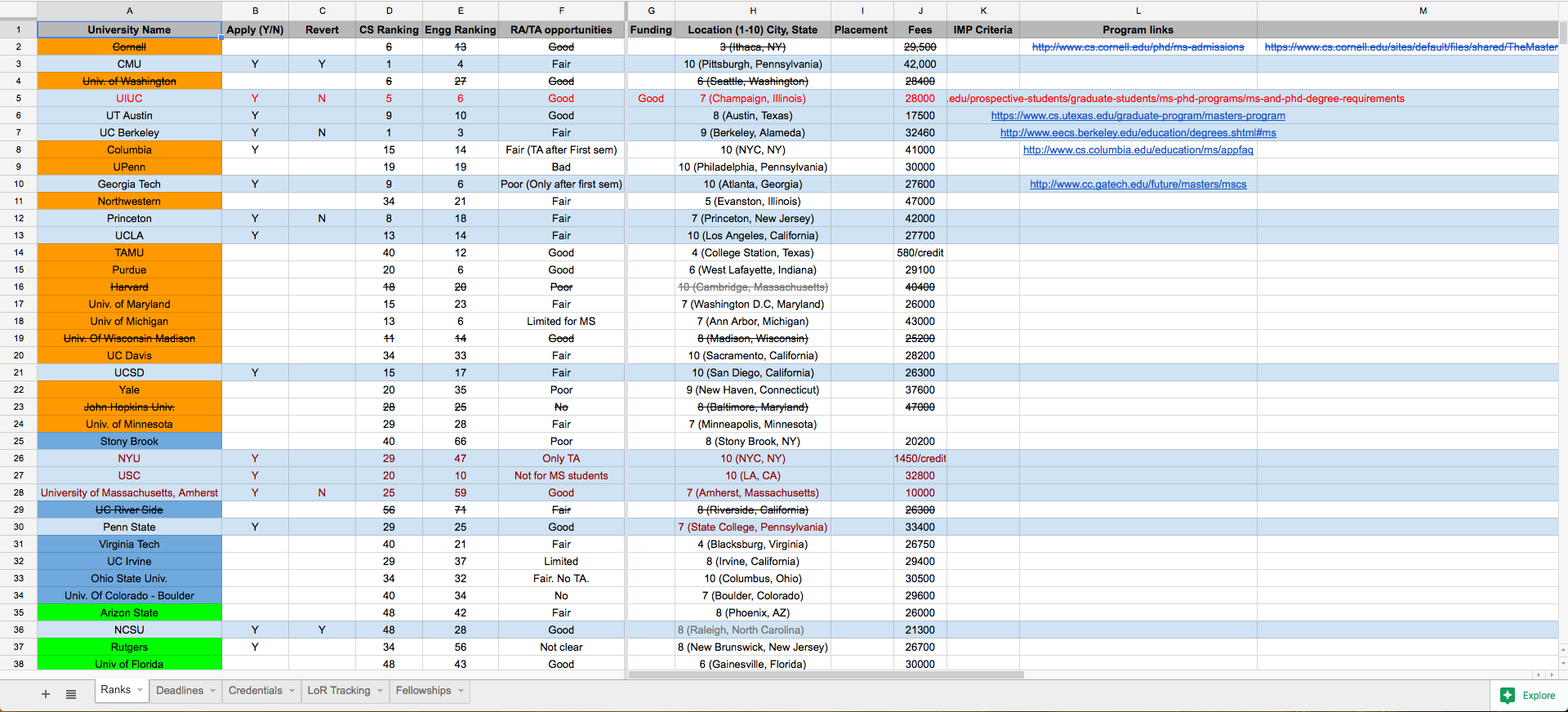
Pick random univeristies. See how their departments in the field you’re applying to are doing, see the research profiles of profs in that department, glance at their projects, maintain records, pick a good set of dream, reach and safe schools.
Fortunately I didn’t have to do much research since I wasn’t sure of which field I later wanted to pursue anyway. So I based my decisions on various other not so important factors. You should pick out categories that matter to you and evaluate schools on those criterion. Ex. Location of the university was important to me, isn’t to most others. (IMO
csrankings.org is a very good resource)
Each school has a hefty application fees so you need to carefully deicide how many you intend on applying to (funny coming from me who thought of applying to 10, ended up applying to 16), how many in each category, etc. You’d be paying the application fees ($80–100), sending GRE and TOEFL scores to the school ($29+17) and the courier fees in case the particular school requires you to mail them a hard copy of your transcript (~INR 2K).
For reference — I applied to 2 safe, 4 reach and 10 dream. Apart from the ones in the sheet, I applied to Stanford (D), UNC Chapel Hill (D) and Rutgers (S).
You might want to consider applying mostly to schools that have seen applications from your university before. Apply to places where you’ve an alumni base (Ex. Gatech and CMU have quite a few IIIT alums). Universities that ACCEPT people from your country, where the streets smell of curry! You also want to go on to sites like
thegradcafe.com to figure out what sort of candidates a certain university prefers. You want to go to UT Austin, but your GPA is on the lower side? Too bad. DON’T APPLY (You could still try though; how do you think I got to 16? Stanford and shizz). Apply to places that match your profile. Some colleges are pure GPA whores. No point applying to those if you’re not one with a GPA to brag about. Some prefer work ex for their program.
GPA
Now, GPA is quite important, that’s for sure. There’s probably not much you can do about it if you’re applying right now. It’s not the end of the world though. A lot of people (myself included) had pretty horrible GPAs but still made it to the program of their choice.
All the different things in your application come together and compensate for one another. Good projects can probably make up for a few low grades. Good GPA can probably make up for something else. All a decent GPA does is assure the selection committee that you give your courses the necessary time, attention and are able to cope with them. Like I earlier said, all you’ve to do is address your low GPA (if you have one) in your SoP; if you’ve a good GPA, BRAG ABOUT IT. Tell them how you always gave your courses a priority and were always onto assignments before anyone else goddamn was!
Letters of Recommendation
This is all about communication. It’s difficult to get a lot of people to write you a glowing LoR. I was fortunate to have amazing profs who didn’t even hesitate to write me 16 frikkin’ recos. I know I wouldn’t have if I was a prof. It’s of the utmost importance for your recommender to be on the same page as you. Tell them clearly how many places you intend to apply to, why you’re applying there, what exactly are you looking for in your dream school, why you think they’re fit to write you a recommendation (in most cases, it’s only coz’ you have no one else to write you one, but then life is nothing but a play of words). Take their advice on schools too! Heck, they might know someone in some school and might be willing to personally put in a word for you!
In the ideal scenario, your LoRs would be submitted on time and you’d just be sitting back and planning your Goa trip towards the end of your college life. In the real world though, it’s quite probable that you’ll be asked to write your OWN recommendation. Awkward. Don’t worry, praise yourself shamelessly for the smallest of things you’ve ever done. Whatever seems off, hopefully your recommender will edit out. It’s also highly likely that your recommendations won’t be submitted on time. All of mine were submitted three weeks late. Yep. ALL. And that sucks when one considers the amount you’re paying just for APPLYING to all those schools.
Chasing your recommenders yet not bugging them out of their MINDS is an art. A highly subjective one at that. Only you can be the true judge of how far you can go; I’ve heard stories of people who showed up at their profs doorstep at 11PM just to remind them that the deadline was a few hours later.
Prof Letting, Counselling Institutions and Scholarships
I was told by a friend of mine about Prof letting. The idea is, once you’ve applied, you send out spam mails to the profs you mentioned in your SoP saying how you love their work, what you’re into, what you’d want to work with them on, etc. You get the idea. The point of it all is, IF (and that’s a big IF) the prof digs it, he/she might ask the committee to pick you. HEY. It COULD happen! That’s all I’m saying.
I personally signed on with The Princeton review to help me “every step of the way” in my application process. Trust me, if you’re reading this and can perfectly comprehend what I’m trying to say, you can spend that 20 grand someplace else. You don’t need them. They help you with your SoP, choosing schools and blah. Big deal. You’re an adult. Do it yourself.
About scholarships. Sadly, there aren’t particularly that many out there. Those that do exist are mostly for natural sciences and the like. You could probably get someone to sponsor your airfare or something like that. I have a record of a few and can help you out with that once you get there. But I don’t think it’s worth it. If you’ve nothing else to do, then go right ahead. I do know there’s something like a TOEFL scholarship for those with excellent TOEFL scores.
Summing it up
So a college looks at a bunch of things. Research background and work experience, I didn’t talk about but it does help to have some. If you don’t, no worries; majority of the applicant pool doesn’t. Just list out your mind numbingly awesome projects and show them how uber cool you are. Make them believe you’re a perfect fit for their university! That there could be ABSOLUTELY no one better to take that spot! Believe it yourself first before trying to convince the person reading your statement.
Also, if you made it till here, you probably guessed I’m not much of a writer. Do excuse my amateur skills in expressing my thoughts. I did try though. That counts.
 #ref-menu