Showing posts with label mock exam. Show all posts

Thursday, November 10, 2016

, , , , , , , , , , , , , , , , , ,

What does the Trump Presidency mean for international students studying in the US?


Surprise surprise! Who knew The Don resonated so well with the American people. We’ll find out in a few years if this was a good decision or not. In the meantime…

The next natural thought is “How will this affect me and my lifestyle?”

Will Donald Trump build a mental ‘Wall’ with the rest of the world and crush my aspirations to be the next Steve Jobs?

Let’s take an in-depth look at this:


  • Local supply doesn’t meet demand –
    Honestly, no matter how much he would want to change this rule, the businessman in him knows better than anyone else the value that international skilled workers bring to USA. He knows that 75% of them stay back and add significantly to the GDP of America. I mean where would the economy be without us international students?


    He knows that local grown graduates are not in enough numbers to fill the rate of job growth. Oh and since he promises to bring MORE JOBS, he definitely needs more people to fill those jobs. This is not even commenting on the quality of the local graduates. Let’s not go there. 😉
  • If Job Growth increases –
    Maybe I should say, when job growth increases, of course, the skilled workers have to come from somewhere. Some will be filled by locals, most will come from this highly qualified international pool of students. Don’t worry, this won’t change. In fact I can see this dependency only increasing. There really was no change when a Republican like George Bush came into power.

  • How will the student loan industry and colleges make money –
    In the interest of business, these two industries will continue to rake in profit of international students in need of a better opportunities. The Don won’t let this change. International students need higher loans than local students. These industries are thriving off international students and IT DEFINITELY won’t change anytime soon. Bad business tactics!

So how will this affect your life?


  • Number of Student Visas issued –
    The number of visas issued won’t change. The process won’t change. The emotions may change amongst the American people with white supremacy getting a win over others. To counter this, show that you belong in America (not by wearing a “Make America Great Again” cap) but by being polished and confident that you have a place in society here; show that you are going to be a contributing member of society; that you have a vision for your life here in the US. Prepare an elevator pitch before the visa interview and pitch it. This should really just come out of your statement of purpose.

  • Number of H1B Visas issued –
    It’s cute that you think his top agenda item would be to reduce the number of work visas, but that won’t happen anytime soon. There are so many more important and pressing national issues that The Don would have to take care of first. Again, since America is lacking in well-qualified, highly skilled white-collar workers, the number and the process of issuing a H1B shouldn’t change. It would be in America’s best interest.

  • Volatility in job market –
    Ah! This is a tough one. The first year or two will be volatile because of all the uncertainty surrounding The Don, his policies and his governing style. Twitter stocks will definitely take a jump with his 3AM major policy announcements on Twitter. To compensate for volatility, companies may not hire as quickly as they would have under Hillary. Spending will slow down initially, but on the flip side, Republicans usually give huge tax breaks to corporations and this will counteract the volatility in the job market.

It’s only fear surrounding The Don, don’t give in to it. Don’t change your plans, because nothing will have changed here. There is a whole part of the economy being sustained by international students and foreign skilled workers.

The takeaway – For once in our lives, we are actually wanted and valued. WOOHOO!!!

Saturday, September 3, 2016

, , , , , , , , , , , , , , , , , ,

Grad school applications  —  What I learned

Now this is a longish post and contains everything I know about applying for higher studies, selecting universities. I was in this situation a few months back and had no idea to do what, where, how, when and for how long. Fortunately, I was able to find someone amazing who helped me out every single step of the way. Honestly, I doubt I’d have been able to get anywhere without her. Not everyone may be able to find someone like this. Even if you do, you may not want to bug someone so much; not to mention, you’d feel much more confident and in control if you yourself had a good idea of what lies ahead and everything that needs to be done.
Of course, if you’re reading this, I assume you’ve decided on wanting to pursue higher education. Your reason may be weird, but if it’s good enough, it works. I’m no career counsellor, and neither are a lot of people. The decision has to be taken by you. In my case, I simply wanted to do a Masters because I felt I needed more exposure to the outside world and a single undergraduate degree from a top institution in the country just didn’t cut it for me. You have a different reason? Sure! Go ahead. I’ve seen people decide overnight they want to do a Masters. Some want to specialise in a field of study, some see it as a ticket overseas, some do it because they don’t want to get into a job too soon. Whatever your reason be, discuss it with your parents, friends and blah. You get the idea.
I’m not too confident about the procedures in the European schools. They’re quite similar to the ones in USofA, but one can never be sure.
So. Where does one start?
Well, there are exams you need to give, universities you need to decide, programs you need to look at, profs and projects you need to delve into, CG you need to maintain (or do you?), resumes you need to build, statements you need to write, profs you need to bug, etc. There’s all that. It can be overwhelming at first, but one step at a time.
So most of the deadlines (for joining the university in the Fall semester) are in December. That means, you’d ideally want to be done with your GRE and TOEFL by September end giving you enough time to write your statement of purpose, decide on schools, etc. (I HAVE seen people give their GRE in late October too and still make it!). Getting done with the GRE early also gives you enough buffer time in case you have to write it again (you can only give it once in three weeks)
Let’s talk about all of these things (approximately in the order you’d be doing them in).

GRE

GRE doesn’t matter as long as you don’t screw it up. The bitter truth is once you are beyond a certain score, the exact number doesn’t really matter.
This is a test on 340 in which there are two sections — English and Quant (both of 170 marks each). There’s a separate section on writing skills which is of 6 marks that aren’t included in the 340. So what’s a safe score? Well, I’d say, as long as you’re scoring above about 320 (325 if you want to be super safe), you’re good. Score above this and your GRE score is not going to matter. The GRE score might come into play in the hypothetical situation that there are two candidates competing for a spot and everything else in their profiles is on par. Too small a possibility to worry about.
The English section needs prep; the quant is something that you’d be quite used to if you’ve been through the traditional Indian schooling system. Assuming you’re putting in a couple of hours a day, I’d say you need on an average of a 3 weeks prep for the GRE (subjective obviously).
To prepare, I had all sorts of books and resources available to me, however the only two things I used were -
Sure Magoosh does cost quite a bit, but it’s worth it. There’s nothing more that you need if you use their test prep software. It’s simply the BEST test prep material out there. If you’re paying so much for the test itself, might as well pay a bit more and make sure you do it right in the first go.
Magoosh has numerous practice questions and stuff that will get one acquainted with the GRE format, things to watch out for in the test, etc.
To prepare for essays, there are some very useful sample essays on the ETS website that one can go through. Each essay is graded on a score from 1–6. The sample essays show how an essay is graded, the difference between a 4/6 essay and a 5/6 one.
ETS also gives you two free tests to take. These tests are the closest they can be to the actual GRE. So it’s often a good idea to take these a few days before the GRE.
Sending your scores
Once you’re done taking your GRE, you need to send these scores to the university you plan to apply to. Sure, you don’t need to do this immediately; you can postpone that for a few months later. But ETS allows you to send the scores to 4 institutions for free right at the end of the test. So it does help to get a fair idea of the colleges you’d be applying to. Sending to more schools costs 29$ per school.
NOTE — You need your passport to give the GRE and TOEFL

TOEFL

Now after the GRE, the TOEFL is a piece of cake to be frank and nothing more than a formality. I gave the TOEFL three days after my GRE.
TOEFL tests you on four parameters — reading, writing, speaking, listening. The only section you’d need to practice would be the speaking section.
The test is on 120 (30 for each section) and the highest filter I’ve seen set by a university for application is 108. Getting above that score should be a piece of cake. I’ve had friends score full in the test.
ETS also lets you send your TOEFL scores to 4 universities for free. However, unlike GRE, the universities need to be decided prior to taking the test. 17 bucks per school after that.

Statement of Purpose

Two pages long. Your best shot to sell yourself to the admission committee. Some universities have their specifications about SoPs though. Some may want it no longer than one page, some set a character limit, etc (Heck, NYU wanted a VIDEO SoP). Irrespective, whoever ends up reading your SoP will in all probability not spend more than a minute or 30 seconds glancing through it.
Write your version 1.0 on your own first. Do not look at someone else’s statement before you do. You run the risk of losing out on your originality otherwise. Then go ahead and take a look at other’s SoPs from the past in the same field as yours. Taking inspiration, make appropriate changes to yours. Get as many people as possible to give you their opinion on it, go through it, suggest changes. Reason with them about the same and make changes you seem fit. Writing an SoP can be a tiring and draining task. Even after 11 or 12 versions, you never really feel like you’re done. There ALWAYS seems to be room for improvement. Writing the SoP can easily take 2–3 weeks. And it’s completely okay to give it this amount of time given it’s importance.
Your statement of purpose gives form and shape to your credentials. Sure, you have your GRE score, your GPA, your internships, publications, projects, etc. but it’s your statement that gives the reader a perspective to view all of that from. A good SoP makes the reader see the good even in the bad (without doctoring any of the details). Your GPA fell drastically in junior year. Well, yeah but you gained loads of experience organising your college fest! You learnt what went wrong and made sure you did better the next semester. Maybe you were instead focussing on your projects which can clearly be seen in that publication you got or the amazing results of the project or the good project grade! What made you take on research projects suddenly? What was the new found motivation? Why did you score poorly in X course? Don’t try and hide the bad stuff hoping they won’t notice. Given the number of applications they go through, chances are they will and if they’re unable to find a reasonable explanation/mention of it anywhere, your application might be discarded without a second thought.
When I was applying to grad school, my CGPA was in the WORST possible situation it could have been. It had been on a CONSTANT decrease since the first semester. Due to the snail paced administration of the college, I had an incomplete grade in my Honours project (which would have helped bring my semester GPA from 5 to a 6 point something, but alas!), I had received my record lowest grades the previous semester and the course of the very specialisation I was applying to (computer vision) — the field I claimed to be an expert in, had a shining C-written next to it. With all of that going on, I should’ve been a straight out reject. But I addressed it subtly in my SoP. That’s probably what saved me. Because if that didn’t, I have no idea what did.
No matter how confused you are, your SoP needs to reflect an absolutely clear stream of thought. I had no idea what in Computer Science I wanted to pursue in grad school. But fact was most of my projects were in Computer Vision (CV), all my LoR’s were from profs very highly regarded in the field, I had a CV internship, a CV paper submitted and awaiting decision (oh yes, even more bad timing. My biggest publication would only have its result out WAY AFTER all the grad school deadlines). So heck yeah, my SoP needed to be all about me wanting to do CV more than anything else. There was no other way to go about it (note that once you’re admitted to a generic computer science program, you can go in and pursue whatever you want; you’re not tied to what you wrote in your SoP)! I tried writing a statement that explained why I wanted to change streams and try something else (with no idea what this something else was); I read it once and trashed it. So even if you’re changing streams, be very careful in the way you go about presenting your situation. Give hard facts that support your thought of wanting to switch.
Also, the problem with most of the SoPs is not the grammar or the fancy vocabulary but the flow of it. It is critical for the whole statement to make the rough storm stricken journey of college seem like a cruise in perfectly calm waters on a nice and bright sunny day. Make sure adjacent paragraphs are connected well, so the reader doesn’t have to go back and forth wondering where some stupid random achievement suddenly butted in from. Get someone to read your statement and check to see if they have a confused expression at any point.

Choosing Schools

Pick random univeristies. See how their departments in the field you’re applying to are doing, see the research profiles of profs in that department, glance at their projects, maintain records, pick a good set of dream, reach and safe schools.
Fortunately I didn’t have to do much research since I wasn’t sure of which field I later wanted to pursue anyway. So I based my decisions on various other not so important factors. You should pick out categories that matter to you and evaluate schools on those criterion. Ex. Location of the university was important to me, isn’t to most others. (IMO csrankings.org is a very good resource)

Each school has a hefty application fees so you need to carefully deicide how many you intend on applying to (funny coming from me who thought of applying to 10, ended up applying to 16), how many in each category, etc. You’d be paying the application fees ($80–100), sending GRE and TOEFL scores to the school ($29+17) and the courier fees in case the particular school requires you to mail them a hard copy of your transcript (~INR 2K).
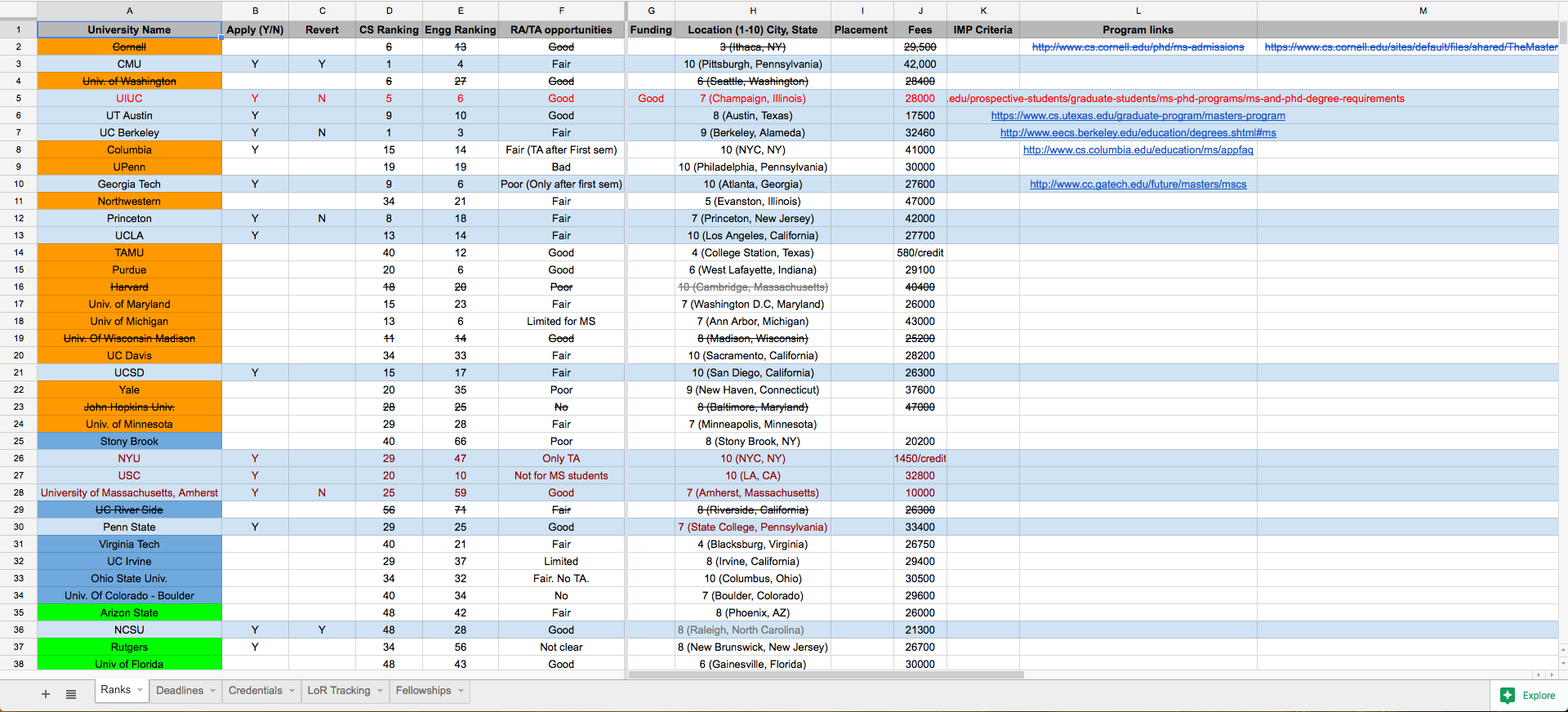
For reference — I applied to 2 safe, 4 reach and 10 dream. Apart from the ones in the sheet, I applied to Stanford (D), UNC Chapel Hill (D) and Rutgers (S).
You might want to consider applying mostly to schools that have seen applications from your university before. Apply to places where you’ve an alumni base (Ex. Gatech and CMU have quite a few IIIT alums). Universities that ACCEPT people from your country, where the streets smell of curry! You also want to go on to sites like thegradcafe.com to figure out what sort of candidates a certain university prefers. You want to go to UT Austin, but your GPA is on the lower side? Too bad. DON’T APPLY (You could still try though; how do you think I got to 16? Stanford and shizz). Apply to places that match your profile. Some colleges are pure GPA whores. No point applying to those if you’re not one with a GPA to brag about. Some prefer work ex for their program.

GPA

Now, GPA is quite important, that’s for sure. There’s probably not much you can do about it if you’re applying right now. It’s not the end of the world though. A lot of people (myself included) had pretty horrible GPAs but still made it to the program of their choice.
All the different things in your application come together and compensate for one another. Good projects can probably make up for a few low grades. Good GPA can probably make up for something else. All a decent GPA does is assure the selection committee that you give your courses the necessary time, attention and are able to cope with them. Like I earlier said, all you’ve to do is address your low GPA (if you have one) in your SoP; if you’ve a good GPA, BRAG ABOUT IT. Tell them how you always gave your courses a priority and were always onto assignments before anyone else goddamn was!

Letters of Recommendation

This is all about communication. It’s difficult to get a lot of people to write you a glowing LoR. I was fortunate to have amazing profs who didn’t even hesitate to write me 16 frikkin’ recos. I know I wouldn’t have if I was a prof. It’s of the utmost importance for your recommender to be on the same page as you. Tell them clearly how many places you intend to apply to, why you’re applying there, what exactly are you looking for in your dream school, why you think they’re fit to write you a recommendation (in most cases, it’s only coz’ you have no one else to write you one, but then life is nothing but a play of words). Take their advice on schools too! Heck, they might know someone in some school and might be willing to personally put in a word for you!
In the ideal scenario, your LoRs would be submitted on time and you’d just be sitting back and planning your Goa trip towards the end of your college life. In the real world though, it’s quite probable that you’ll be asked to write your OWN recommendation. Awkward. Don’t worry, praise yourself shamelessly for the smallest of things you’ve ever done. Whatever seems off, hopefully your recommender will edit out. It’s also highly likely that your recommendations won’t be submitted on time. All of mine were submitted three weeks late. Yep. ALL. And that sucks when one considers the amount you’re paying just for APPLYING to all those schools.
Chasing your recommenders yet not bugging them out of their MINDS is an art. A highly subjective one at that. Only you can be the true judge of how far you can go; I’ve heard stories of people who showed up at their profs doorstep at 11PM just to remind them that the deadline was a few hours later.

Prof Letting, Counselling Institutions and Scholarships

I was told by a friend of mine about Prof letting. The idea is, once you’ve applied, you send out spam mails to the profs you mentioned in your SoP saying how you love their work, what you’re into, what you’d want to work with them on, etc. You get the idea. The point of it all is, IF (and that’s a big IF) the prof digs it, he/she might ask the committee to pick you. HEY. It COULD happen! That’s all I’m saying.
I personally signed on with The Princeton review to help me “every step of the way” in my application process. Trust me, if you’re reading this and can perfectly comprehend what I’m trying to say, you can spend that 20 grand someplace else. You don’t need them. They help you with your SoP, choosing schools and blah. Big deal. You’re an adult. Do it yourself.
About scholarships. Sadly, there aren’t particularly that many out there. Those that do exist are mostly for natural sciences and the like. You could probably get someone to sponsor your airfare or something like that. I have a record of a few and can help you out with that once you get there. But I don’t think it’s worth it. If you’ve nothing else to do, then go right ahead. I do know there’s something like a TOEFL scholarship for those with excellent TOEFL scores.

Summing it up

So a college looks at a bunch of things. Research background and work experience, I didn’t talk about but it does help to have some. If you don’t, no worries; majority of the applicant pool doesn’t. Just list out your mind numbingly awesome projects and show them how uber cool you are. Make them believe you’re a perfect fit for their university! That there could be ABSOLUTELY no one better to take that spot! Believe it yourself first before trying to convince the person reading your statement.
Also, if you made it till here, you probably guessed I’m not much of a writer. Do excuse my amateur skills in expressing my thoughts. I did try though. That counts.

Wednesday, July 13, 2016

, , , , , , , ,

Scholarships for Indian students applying abroad for graduate studies


If you happen to be an Indian student seeking opportunities to study abroad, then you’ll be pleased to know that international scholarships for Indian students are offered by an ever-growing number of governments, organizations and specific universities. Below is a diverse selection of international scholarships on offer to Indian students, divided by funding type and desired place of study. 

(Click on the name of the scholarship to apply and know more)

To study anywhere:


British Council IELTS Scholarship Award for Indian Students – international scholarships funded by the British Council exclusively for Indian students who have taken a recent IELTS test with the BritishCouncil. Open to students of all levels studying outside of India.

Inlaks Shivdasani Foundation scholarships–scholarships for Indian students to study abroadin North America or Europe. Applicants must be under 30 and reside in India at the time of application. For undergraduate and postgraduate study. Other restrictions apply.

To study in the US:


Asian Women in Business Scholarship Fund– offering female Asian students the chance to receive funding for an undergraduate business degree taken at an accredited US university.

Fulbright-Nehru Research Fellowships– offering funding to outstanding Indian students wishing to pursue study at any level within an accredited US institution. See individual scholarships for specific criteria.

S.N. Bose Scholars Student Exchange Program for Indian Students– opportunities for Indian researchers at master’s level or higher to study a selected program in the field of science and technology at a university in the US.

Stanford Reliance Dhirubhai Fellowships for Indian students scholarships for Indian students to study at Stanford Graduate Schoolof Business on the MBA program. To be eligible students must return to India within two years of completing their studies.

To study in Asia:


Aichi Scholarship Program for Asian Students in Japan– various scholarships for Indian students studying at graduate level in Aichi Prefectural government-approved manufacturing programs inJapan.

DST A*STAR Call for Singapore-India Joint Research Grants– grants for Indian researchers within the fields of science and technology to study in Singapore. Sponsored by the Indian government and A*Star Singapore.

Hinrich Full MA Scholarship in International Journalism at HKBU– open to citizens from India, Myanmar and Vietnam, offering scholarships to study the Masters of Arts in International Journalism program at Hong Kong Baptist University in Hong Kong.

HM King’s and HM Queen’s Scholarships for Asian Students in Thailand Thai government scholarships for Indian citizens to study in Thailand at master’s level within engineering and technology, management or environment and development at the Asian Institute of Technology (AIT).

Silk-Road Scholarship Program at Seoul National University– scholarships for Indian students to study abroad in South Korea at Seoul National University, on graduate-level humanities or social science programs.

Zhejiang University Asian Future Leaders Scholarship Program– international scholarships for Indian students undertaking a two-year English-taught master’s degree in public administration at Zhejiang University.

To study in Australia:


University of Adelaide Ashok Khurana Scholarship for Indian Students– scholarships for Indians undertaking postgraduate study in selectedfields at the University of Adelaide.

University of Queensland India-Australia BEL Excellence Scholarship–full-tuition international scholarships for Indian students studying at master’s level within the Faculty of Business, Economics and Law at the University of Queensland in Australia.

University of Queensland Postgraduate Coursework Scholarships another set of scholarships from the University of Queensland, this fund is open to students from India or Latin America to undertake coursework-based postgraduate study in biology-related subjects.

To study in New Zealand:


India New Zealand Sports Cooperation Scholarships (INZSS)– New Zealand government scholarships for Indian students to study abroadin New Zealand on any degree-level sport- related program at participating universities and institutes.

To study in Europe:


France


Alcatel-Lucent: HEC Paris Scholarshipfor Global Leadership Potential– opportunity for Indian, Brazilian, Chinese and Russian students to gain funding to study a master’s degree atHEC Paris.
GDF Suez/MEEA Scholarships– on offer to citizens of India, Lebanon, Chile and Brazil pursuing master’s level study at the École Polytechnique in Paris.

Spain


INSEAD Louis Vuitton MBA Scholarship for Indian and Chinese Students– a scholarship for nationals of China and India, who have been accepted into the INSEAD Business School MBA program.
Netherlands

Dr. Ursula Glunk Scholarship for Master Students at Maastricht University– international scholarships for Indian students to study abroad in the Netherlands at Maastricht University. Open to students admitted to the master’s program in media culture.

UK


Birkbeck University International Office Merit Scholarships– open to students from India, Vietnam and Thailand to undertake a one-year master’s degree at Birkbeck University in London.

British Council GREAT scholarships for Indian Students– a number ofscholarships for Indian students to study abroad in the UK.

Cardiff Business School India Scholarships– scholarships for Indian students to study abroad in the UK at Cardiff Business School. Eligible candidates are those studying any taught postgraduate program.

Heriot Watt SML International Merit Scholarships for Indian Students– open to Indian students at postgraduate level studying at Heriot Watt University in the UK on a taught program within the School of Management and Language.

Imperial College India Foundation Postgraduate Scholarships– scholarships for Indian students studying at Imperial College London, providing funding for master’s or PhD studies in selected programs.

King’s College London Emerald MSc Studentship– full studentship offered to master’s students from India, Nepal, Uganda, Nigeria, Ethiopia and South Africa to pursue further study in the field of global mental health at King’s College London (KCL).

King’s College London PhD Studentships for Indian Students– King’s College London (KCL) offers two fully funded studentships to Indian students studying for PhDs in the field of modern Indian intellectual history or history of ideas at KCL.

London Metropolitan University Mahatma Gandhi Scholarship for Indians– a single, merit-based scholarship open to Indian students undertaking study at master’s level at London Metropolitan University.

LSE India Scholarships for Master Students– offering up to 40 scholarships for Indian students to study abroad in the UK at the London School of Economics. Open to master’s degree students, awarded based on financial need.

Ms. Agatha Harrison Memorial Fellowship at St. Antony’s College– Indian government fellowship offered to Indian students pursuing study at the University of Oxford’s St. Antony’s College in the field of history, economics and political science. Only available to high-achieving postgraduate research students.

Newcastle University Undergraduate India Scholarships– two undergraduate scholarships for Indian students studying at Newcastle University in the UK within selected faculties.

Oxford and Cambridge Society of India (OCSI) Scholarships– open to Indian students at any degree level to study at Oxford University or theUniversity of Cambridge in the UK.

Saltire Scholarships – scholarships for students from Canada,  the US, India and China to study in Scotland at any degree level.

Sir Ratan Tata Fellowships for South Asian Students at LSE– scholarships for social science students from South Asia to study at the London School of Economics (LSE) in the UK within the LSE Asia Research Centre (ARC).

Sussex India Scholarships for Master’s Students offering opportunities to gain funding at the University of Sussex in the UK for Indian students at master’s degree level.

UCD Global Graduate Scholarships for Indian Students in Ireland– funding opportunities for Indian students at graduate level studying atUniversity College Dublin in Ireland.

University of Aberdeen Indian Master Scholarships offering 20 scholarships for Indian students to study a master’s degree at the University of Aberdeen Graduate Business School in Scotland. Not open to MBA candidates.

University of Bournemouth Business School Dean’s Scholarships for Masters Students– scholarships for international students to study a taught master’s program at Bournemouth University in the UK. Indian,Chinese and South Korean students are eligible for a 25% award.

University of Dundee Rio Tinto Fully Funded Postgraduate Scholarships– offering various postgraduate scholarships to international students studying at Scotland’s University of Dundee.

University of Edinburgh Principal’s Indian Masters Scholarships– 12 scholarships available to Indian students studying at the University of Edinburgh in Scotland at master’s level.

University of Oxford Felix Scholarships for Indian Students– graduate-level funding opportunities for Indian students studying at the UK’s University of Oxford.

University of Sheffield Vice Chancellor’s Indian Scholarships– offering10 scholarships for Indian students undertaking PhD research at the University of Sheffield in the UK.

University of Southampton LLM International Scholarships– international scholarships to study law at postgraduate level at the UK’s University of Southampton. Open to citizens of India, Turkey, Hong Kong, Thailand, and Canada.University of Warwick Law School Postgraduate Taught Scholarships– scholarships for Indian students studying any taught law program at the University of Warwick.

UWE Undergraduate Excellence Scholarships– UWE Bristol University in the UK is offering undergraduate scholarships for Indian, Nepalese and Pakistani students.

Westminster International Partnership Scholarships scholarships for Indian students and other international students at all degree levels studying at the University of Westminster.

Ireland


DCU International Student Scholarships for Indian Students in Ireland– offering scholarships to study abroad in the UK at Dublin City University in Ireland. Open to full-time undergraduate and postgraduate Indian students.

WIT Indian ‘Wicket Scholarship– offering a scholarship to one Indian student annually to undertake study at Ireland’s Waterford Institute of Technology. Open to undergraduate and master’s degree students.

Credits - topuniversities
, , , ,

Milestone and Timeline to Complete PhD

Completing PhD is not an easy task. It takes special dedication and determination to even think of applying for PhD.
Following article will give in-depth idea about the steps required to complete PhD degree and approximate time to complete doctorate degree.

Steps To PhD Degree

You will need to follow these steps along the path to the Ph.D.
  1. PhD students should have knowledge about various area of their Major. So, first 2 years you will be taking variety of courses (Diversity courses).  You will do this at the same time you are doing the next step:
  2. Find a supervising professor and identify a research area (but not a specific topic at this point). In consultation with your advisor, choose three courses (in addition to your diversity course). Choose courses designed to prepare you for the research you plan to do.
  3. Schedule a Research Preparation Exam.
  4. Submit a Research Qualification (RQ) Document to the Graduate Office. In the RQ document, the student:
    • Provides evidence of satisfying the background requirements
    • Submits coursework (5 Diversity courses completed and 3 Depth courses, some of which may remain to be taken) with satisfaction of the GPA requirements
    • Provides evidence of completing the Research Preparation Exam
    • Formalizes dissertation advisor(s)
    The RQ document must be filed by the end of the 3rd year in the PhD program.
  5. Become PhD Candidate
    • With the assistance of your supervising professor, select a committee.
    • The Graduate Adviser must approve your committee prior to making final committee plans
    • Select a date and time when all committee members can be present for the proposal.
    • Pass the proposal exam.
    • After passing your proposal exam, you will need to complete an  Application for Candidacy
  6. Schedule and Pass the Final Defense
    1. At least 4 members of the 5+ member committee must be present. Non-attending members must provide written explanation for their absence and must agree to read and comment on the dissertation by the time of the defense.
  7. Submit the Dissertation to the Graduate School.

PhD Graduation Timetable

MilestoneTime Since Admission
Completion of diversity courses1.5 – 2 years
Submission of RQ proposal2 – 2.5 years
Admission to candidacy2.5 – 3.5 years
Dissertation defense3 – 5 years
Timeline and procedure will vary between universities, but above listed steps will give an overall idea about completing PhD and time required to complete Doctorate degree. You can pply for PhD right after Bachelors degree (B.E., BSc or B.S.). You maybe be required to take additional coursework during first 2 years.

Sunday, July 10, 2016

, , , , , , , ,

Why NOT to be without health insurance in US?


Health Insurance… If you do not have it,  FIRST GET IT !  Many people do not realize the importance of health insurance in America. It is a MUST.  Some may argue,  I am in good health condition and it is a waste of $100 or $300 for health insurance. But, we do not plan accidents. Lets imagine, you are walking down the road and just slipped for some reason and fell down. In other countries, you can go to doctor and get decent treatment for less money. Guess what in America, if you do NOT have health insurance, you may spend a LOT of money. Can be anywhere from $500 – $50,000 or more. May be I am overstating, but the reality is it costs you a LOT of money without health insurance. This article just explains the importance of having health insurance in USA. Let me show you quick pricing comparison of just one treatment.

Medical TreatmentCost in India without InsuranceCost in US Without InsuranceCost in US with insurance
MRI ScanRs 4000 – Rs 7000 ($90 – $155)$700- $2500Can be FREE after you reach the deductible and insurance Policy
Also, let’s say if you call 911 and take Ambulance, it can cost you anywhere from $300 to $700 or more. Check this article:  Did you know How much Ambulance Costs? . If you have proper insurance you might get this free. But, it depends on the plan though. Let me tell you a real story of a friend of mine, he was just going on a bike and fell down. He did not have proper insurance. For some reason, the health insurance did not cover the expenses. He had his elbow broken and it was bad. Probably, in India he would have got away with Rs 40,000 to Rs 50,000 if he were to go to a nice fancy hospital. If not, around Rs.10,000 to Rs.50,000. Guess what my friend had to pay ?  It cost him $45,000 Dollars. It is equivalent to Rs 20,25,000 ( over 20 Lakhs). You can just compare the numbers and realize the importance of health insurance. Even if you do not compare, that’s a lot of money in US dollars and it is years of savings for average Americans. Here is the thing in America, most of the times, you will not be left out and forced to bear pain with a broken arm or anything like that. The hospitals do treat you well, but they will take your SSN and other contact information and send you all the bills home.  You cannot escape from bills and collection agencies. They get you there and you will end up paying all your life, just medical bills. So, be careful and take insurance right away if you do not have. In future articles, I plan to write the types of health insurance and what is best one to choose if you had a choice… Refer to following if you need references for comparison,